
TPO vs PVC Commercial Roofing in Gardena CA: What to Choose for Your Building and Why
- Home
- TPO vs PVC Commercial Roofing
If you manage a commercial building in Gardena, your roof is probably not a set it and forget it situation.
Between the sun, the occasional heavy rain stretch, and constant rooftop traffic from HVAC techs, signage, and routine maintenance, low slope roofs here take a quiet beating. Most problems do not show up all at once. They show up as little clues. A seam that looks tired. A patch that keeps coming back. A stain that appears in the same spot every winter. A drain area that ponds longer than it should.
That is usually when the question pops up.
Should we go with TPO or PVC
Both are common. Both are reflective. Both are heat welded systems. Both can be installed in ways that perform really well.
But they are not identical, and in Gardena, the difference can matter depending on what your roof goes through day to day.
This guide breaks the decision down without the fluff. You will learn what actually separates these systems, what building conditions push the choice one way or the other, and what you should make sure is included in the materials list so the roof performs as a system.
If you are building a quote or planning an order, this blog is also designed to naturally support your key pages like Commercial Roofing, Roofing Materials, Roofing Material Delivery, Roof Leak Repair, and Contact.
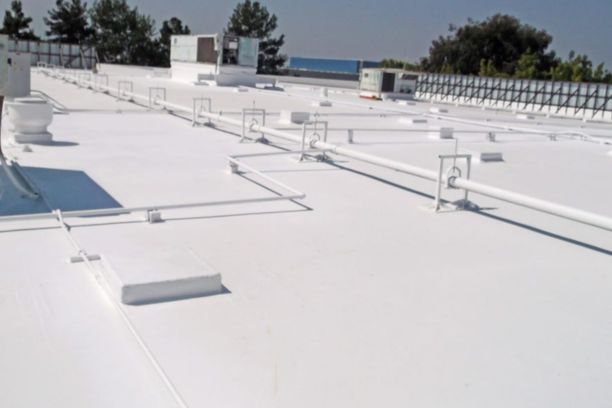
Why Gardena commercial roofs have their own set of problems
Gardena sits in that South Bay zone where you can feel coastal influence without being right on the sand. Some mornings you get that marine layer. Some days feel dry and hot. When storms hit, they can hit fast. And on flat roofs, water does not just slide off like it does on a steep shingle roof. It collects in low areas, it finds weak transitions, and it punishes bad drainage.
The other factor is foot traffic. Commercial roofs are working platforms. People walk them constantly. Equipment gets serviced. New penetrations happen. Old penetrations get reworked. Even the best membrane system can get damaged early if the roof is treated like a parking lot with no protection plan.
So the real decision is not only TPO versus PVC.
It is which system fits your roof environment, your maintenance reality, and your budget over time.
First, what TPO and PVC are in plain words
TPO is a thermoplastic single ply membrane. It is installed on low slope roofs and the seams are typically heat welded. When welded properly, those seams can be strong and watertight.
PVC is also a thermoplastic single ply membrane, also heat welded, also used on low slope commercial roofs.
So why do people debate them so much
Because the differences show up in long term behavior, chemical exposure, and how forgiving the system is for certain building conditions.
The questions that decide the right choice
If you want a quick way to make the decision, do not start with brand names. Start with your roof conditions.
Here are the big questions that decide most Gardena jobs.
1. Does your roof deal with ponding water
Ponding water is not just annoying. It is the kind of thing that turns minor issues into repeat leaks.
If the roof has areas where water consistently sits, your membrane choice and your detailing strategy matter more.
In these situations, a building owner might also consider whether drainage corrections, tapered insulation, or targeted rebuilds are part of the scope, not just a new membrane layer.
The honest truth is this.
If a roof ponds because it was built that way and you are not correcting slope, you need a system that will hold up under those conditions and you need a stronger focus on drain area detailing.
2. Is there grease, oils, or chemical exposure on the roof
This is the category that makes the conversation very easy for some buildings.
If your building has food service, kitchen exhaust, or grease discharge that ends up on the roof surface, material compatibility becomes a big deal. Grease exposure can shorten the life of certain roof surfaces and it can make maintenance more difficult.
In many real world specifications, PVC tends to be the system people lean toward when chemical or grease resistance is a top concern.
That does not mean TPO cannot be used, but it does mean you should not let this be a purely price driven decision if your roof is constantly exposed to grease.
3. How much roof traffic does the building have
If you are managing a building where techs are on the roof every week, the roof needs a plan for that.
It is not enough to pick a membrane and hope people are careful.
High traffic roofs typically need:
- Walkway pads in service routes
- Reinforced details around equipment
- Clear protection at pinch points like ladder access zones
- A maintenance plan that catches small punctures before they become leaks
Both TPO and PVC can be specified with reinforcement and accessories, but the key is that you plan it upfront.
4. Is cool roof documentation part of the permit or project requirement
In California, cool roof performance and documentation often come up in commercial reroofing and restoration projects, depending on scope and building type.
Even when the building owner is not thinking about energy code, the inspector or plan reviewer might be.
Reflective membranes can help here, but the ratings and documentation need to match the exact product being installed.
The easiest way to avoid headaches is to plan for the documentation early, not at the end.
5. Are you trying to extend the roof life or replace it for the next long cycle
Some building owners want a solution that buys time. Others want a system they can rely on for a long cycle with fewer surprises.
That changes the way you approach insulation, cover board, attachment method, and detailing.
How TPO tends to perform on Gardena commercial roofs
TPO is commonly chosen because it can be a strong value option.
When specified and installed correctly, it can deliver a reflective roof surface, good performance, and a clean installation.
Where TPO shines is often in buildings that:
- Have normal rooftop traffic
- Do not have heavy grease exposure
- Have decent drainage or manageable ponding zones
- Want a cost conscious system that still performs well
Where TPO can struggle is usually tied to the install quality and roof environment, not the idea of TPO itself.
If welds are inconsistent, details are rushed, or the roof is constantly exposed to grease and chemical discharge, long term performance can be affected.
So if you choose TPO, the key is not only the membrane.
It is the full assembly and the installer’s attention to details.
How PVC tends to perform on Gardena commercial roofs
PVC is often chosen when the building environment is harsher.
This includes buildings with:
- Grease exposure or chemical discharge
- Higher risk roof surface conditions
- Roofs where durability and resistance to certain exposures matter more than being the lowest initial cost
PVC systems are often considered more appropriate for certain harsh roof environments because of their chemical resistance reputation in many commercial use cases.
The trade off is often cost. PVC can cost more, and like any system, it still requires good installation and strong detailing.
A roof system can be premium on paper and still fail if penetrations and terminations are sloppy.
The part that matters more than membrane choice
This is the part most property managers eventually learn the hard way.
Most commercial roof leaks do not start because the field membrane is bad.
They start at details.
If you want a commercial roof that stays calm in rain season, focus on:
- Penetrations and pipe details
- HVAC curb transitions
- Drain bowls and scupper edges
- Parapet terminations and edge metal
- Seams and transitions near movement points
That is why it is smart to treat membrane selection and accessory selection as one package.
A new membrane with old tired drain details is still a leak waiting to happen.
What to include in the materials list so the job does not stall
Here is where projects lose time.
Somebody orders membrane rolls and insulation, but forgets the small items that actually finish the roof.
A complete commercial membrane project typically needs:
- Field membrane
- Insulation and cover board as specified
- Attachment system, either mechanical fasteners, adhesive, or a hybrid
- Prefabricated boots for penetrations where possible
- Inside and outside corners
- Drain and scupper details
- Termination bars and compatible sealants
- Walkway pads for service routes
- Repair materials for punch list and future calls
If a building has leak history, it is also smart to have repair materials ready even during a new install because field conditions can uncover surprises. That is where your Roof Leak Repair page ties in naturally.
If the project requires decking repair or blocking, that is where Construction Materials becomes part of the same order.
Delivery planning that prevents day one chaos
Delivery is not glamorous, but it decides whether the crew starts strong or starts frustrated.
For Gardena projects, the most common delivery problems are:
- Tight access and parked vehicles
- Limited staging space
- Deliveries arriving after tear off begins
- Missing accessories that force a second trip
The fix is simple.
Order like a kit, then schedule Roofing Material Delivery so materials arrive in the right order and land in the right place.
If the building is a busy retail strip or industrial yard, it helps to stage the drop zone before the truck arrives. A quick site photo and a clear instruction can prevent a lot of confusion.
Coatings and why they sometimes belong in the same conversation
You might be reading this thinking you are not sure you need a full membrane replacement.
That is fair.
In some cases, a reflective coating system can be used as a restoration path when the roof is still structurally sound and the goal is to extend service life.
That is why coatings and membrane systems show up in the same planning meetings. The right choice depends on roof condition, moisture status, and the type of failure happening.
If you want a quick way to decide between restoration and replacement, ask this:
Is the roof dry and stable enough to restore, or are we trying to cover a failing system
If you are covering a failing system, the problems come back.
A quick decision guide for common Gardena building types
Here is a simple way to match the system to the building.
Retail strip or office with typical HVAC traffic
TPO or PVC can both work. Focus on good detailing, drain areas, and walkway protection.
Restaurant or building with grease exhaust
PVC often becomes the safer starting point to discuss, especially if roof staining and grease exposure are consistent.
Warehouse with frequent roof access
Either can work. Prioritize thickness, reinforcement, walkway planning, and strong edge and drain detailing.
Older building with recurring leaks and ponding zones
Membrane choice matters, but roof condition matters more. Evaluate moisture and drainage first, then choose the system that fits what you find.
Closing thought
The best roof decisions feel boring.
They are not about what is trending. They are about what will stay watertight, reflective, and serviceable when the building is dealing with real life conditions for the next decade.
If you want a clean materials plan that matches your building and your roof conditions, start with Roofing Materials, confirm accessories through Roof Leak Repair and Construction Materials if needed, then schedule Roofing Material Delivery so the job starts on time.
If you want help choosing the right TPO or PVC system and building a complete order list, the simplest move is to use Contact with a few details about your building, your roof size, and what you are dealing with up there.
Share:



Related Posts
Roofing Materials Delivery in Gardena CA Jobsite Checklist
If you live and work in Southern California long enough, you start to notice something…
Roof Leak Repair in Gardena CA: Common Leak Spots and…
If you live and work in Southern California long enough, you start to notice something…
TPO vs PVC Commercial Roofing in Gardena CA
If you live and work in Southern California long enough, you start to notice something…
Get in Touch with Our Roofing Experts Today
Lorem ipsum dolor sit amet, consectetur adipiscing elit. Ut elit tellus, luctus nec ullamcorper mattis, pulvinar dapibus leo.
Whether you’re a homeowner or a contractor, Roof Supply Company delivers dependable, top-grade roofing materials across Gardena and surrounding areas.
Services
Contact Info
- (213) 596-8052
- 15934 S. Figueroa St. Gardena, CA, 92048
- Mon - Fri : 6.00 AM - 4.00 PM
- Sat : 7.00 AM - 11.00 AM
- Sun : Closed
Copyright ©2026 The Roof Supply Company. All Rights Reserved.